Logo Fundación Arquia
Logo

Centro de documentación FQ

Si aún no lo conoces te explicamos Qué es el Centro de Documentación FQ de Fundación Arquia

Contacto

Sede Oficinas

C/Barquillo, 6, 1º izda. 28004 Madrid

Sede Actividades Culturales

C/ Tutor, 16. 28008 Madrid

91 756 10 50

centrodocumentacion@arquia.es

Suscríbete

Suscríbete a nuestro boletín para estar al día de las últimas novedades y lanzamientos.

Al suscribirte, aceptas nuestra Política de Privacidad y das tu consentimiento para recibir actualizaciones de nuestra empresa.

© 2026 Centro de documentación FQ. Todos los derechos reservados.

Política de cookiesPolítica de privacidad
Centro de documentación FQ
InicioCatálogoCiclos
Logo

Centro de documentación FQ

InicioCatálogoCiclos

Cargando realización...

All that is material will be standard, and all that is personalized will be virtual (Articulo publicado en Volume 28, Julio 2011, Amsterdam-Holanda) | Arquia - Centro de Documentación
  1. Inicio
  2. /Catálogo
  3. /Realizaciones
  4. /All that is material will be standard, and all that is personalized will be virtual (Articulo publicado en Volume 28, Julio 2011, Amsterdam-Holanda)
RealizacionesPróxima

All that is material will be standard, and all that is personalized will be virtual (Articulo publicado en Volume 28, Julio 2011, Amsterdam-Holanda)

Galería realización

In the end, all that is material will be standard, and all that is personalized will be virtual. Unique pieces will be unsustainable because of price and energy expenditure, if we wish to supply the masses. This may sound like science fiction, but the virtual world will be the technology we use to define the super-dense city.

Descripción

The largest migration in human history is looming. And if we are impressed now by Shanghai - with its ten million inhabitants - in 20 years, there will be ten new satellite towns in its perimeter, which will make the city swell to 100 million people.

To create hyperdense cities, architects must also think about the social relations to be established; they cannot limit themselves to constructing buildings. They must consider how to coordinate future life in the cities and help the public get ready to inhabit them.

The solution will tend towards an updated version of Levitt’s work. The way to optimize the production chain will be sought for reasons of sustainability and economic profitability. An efficient, cheap and quickly-built system needs to be defined to ensure minimum conditions of quality for the population. The solution must be a temporary one that consists in easily assembled, small accommodations clustered in high density. The housing’s uniqueness will need to be developed so that its inhabitants enjoy some degree of comfort. Just as the rise of the automotive industry made the commute to Levitt’s homes possible – which led to individualized travel –a technology that allows people to live in hyperdense cities will need to be developed.

The technology that will lead us to create this new way of life will be the virtual environment (the 3D environment of a fantasy world in which each person is represented by an avatar). New technologies change social relations as well as our personal experiences. We use them to replace basic aspects of our existence such as living, feeling and touching with browsing, accessing or customizing. We need another kind of reality that allows us to survive emotionally. The virtual world allows a person who lives in a huge block, in a giant hive, to keep one’s “virtual self” in the town where he was born and has always dreamed of living. It gives one access to what one cannot actually have or to the friends left behind in the move from the countryside to the city. The Chinese can adapt to this way of life because physical objects have no value except in the relationships they create. The new generations, who are teens today, no longer distinguish between the virtual and real worlds. It is all the same thing, although virtuality is closer to their way of understanding life. Instant messaging and Facebook allow them to be instantly close to their friends, music, vacations and interests. What they see on a daily basis is boring in comparison with the inputs they receive from their virtual friends. Their physical environment no longer is important if they have access to the Internet. And that is the citizen who can survive in an hyperdensified environment: someone who does not need the material public space because he or she will find it in the virtual space, someone who will find everything related to the personal virtually because physically he will not be able to pay for it or simply because it is not worth acquiring something that means a burden on their extreme mobility.

The shift has already begun. The virtual world is intertwined with reality. Renderings convince politicians and decide competitions that become built realities. Their glitter and lights attract the masses. The strange thing is that built architecture is ever closer to that virtual architecture.

In the end, all that is material will be standard, and all that is personalized will be virtual. Unique pieces will be unsustainable because of price and energy expenditure, if we wish to supply the masses. This may sound like science fiction, but the virtual world will be the technology we use to define the super-dense city.

Autoría y colaboradores

Autor

Sancho Pou, Eduard (1974-)

Información

Clasificación / Tipología

Web y medios digitales

Dirección

VOLUME, Archis foundation, PO Box 14702, PAÍSES BAJOS

Fecha de fin

2011-07-20

Sección

Próxima
III Edición 2010-2011
2012
IV Edición 2012-2013
2014

También te puede interesar

Extrapolating the jewelry scenario to architecture (Conferencia en la Economy Conference 2011 WSA, Julio 2011, Cardiff - R.Unido)
RealizacionesPróxima

Extrapolating the jewelry scenario to architecture (Conferencia en la Economy Conference 2011 WSA, Julio 2011, Cardiff - R.Unido)

Small craftsmen (architects) will disappear because they do not understand the value of a brand. And they do not understand that competitions are won by a rendering, a slogan, or simply the name of a foreign architect. They do not realize that the profession has changed and that those commissioning projects are looking for new values.
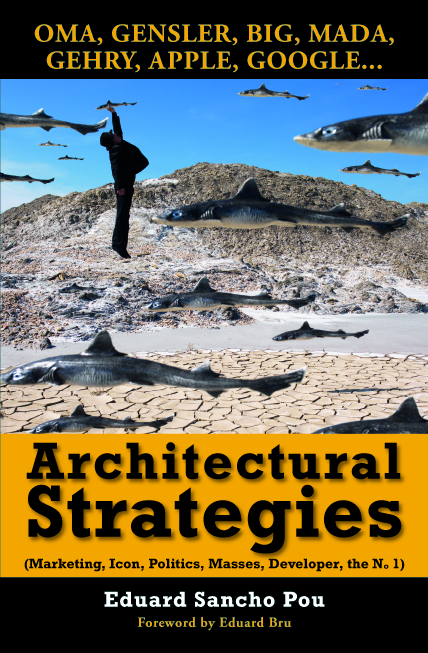
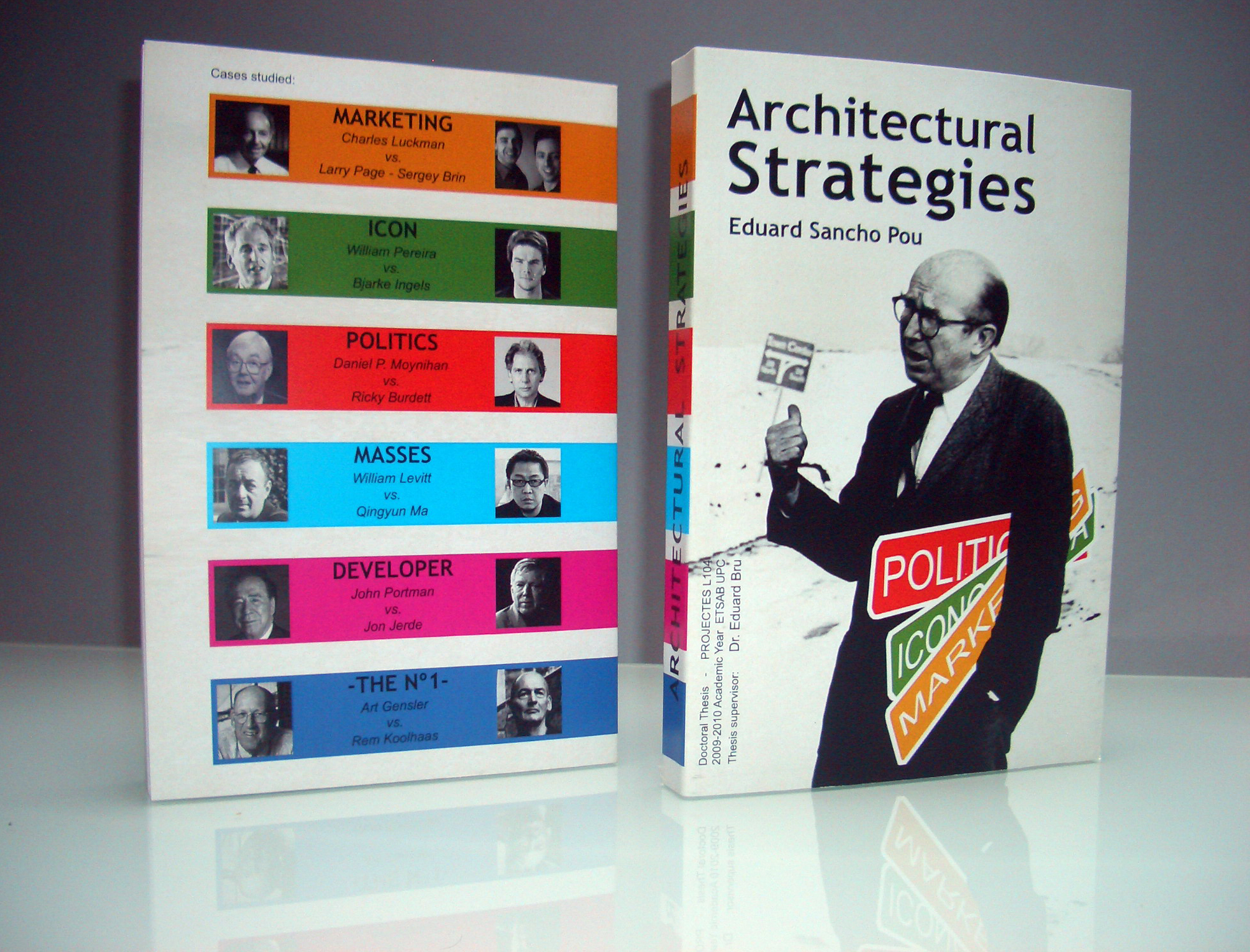
Architectural Strategies (Marketing, Icon, Politics, Masses, Developer, the no.1)
RealizacionesPróxima

Architectural Strategies (Marketing, Icon, Politics, Masses, Developer, the no.1)

TITLE: Architectural Strategies (Marketing, Icon, Politics, Masses, Developer, the no.1)

AUTHOR: Eduard Sancho Pou / Foreword by Eduard Bru

FORMAT: 15 x 23 cm

PAGES: 208 pages (ills colour & bw, 20 photographs)

BINDING: Paperback

LANGUAGE: ENGLISH

EDITOR: Ediciones Península (Grup 62 - Planeta)

ISBN: 978-84-9942-195-7

PRICE EU: 19,50 €

DISTRIBUTOR: IDEA BOOKS (www.ideabooks.nl) Idea Code 12489

Art Gensler, founder of Gensler, San Francisco: Global firm with more than 3,000 architects and 42 offices worldwide.

“I found your book fascinating and very well done. I believe your concepts in the article Gensler and OMA are correct.”

Bjarke Ingels, founder of BIG, Copenhagen and New York based group of architects. Visiting Professor at the Yale School of Architecture

“Eduard Sancho Pou interprets architecture from the point of view of what seems to work in the complex economic, political, commercial and social reality inherent in today’s global situation. A fresh take on architecture seen through strategy rather than theory.”

Stephen Bates, founder of Sergison Bates architects, offices in London and Zurich. Professor of Urbanism and Housing at TU München.

“The conclusions encourage greater strategic thinking, and this is the books’ most positive message because it promote action in practice, encouraging the architect to instigate, as much as to react.

Manel Gausa, dean of the Institut Arquitectura Avançada Catalunya (IAAC) and director of the Doctoral School of the University of Genova UNIGE.

“This book offers a fresh interpretation of the figure of the architect, which has always been linked to design and is now starting to be linked to entrepreneurial adventure, intellectual adventure and cross-sectional adventure, in which research is fundamental.”

Alfredo Pastor, professor of Economics at IESE Business School and holder of the Banco Sabadell Chair in Emerging Economies, Barcelona

"Architectural Strategies may seem harsh in that it views architects no longer as professionals, but as consultants. Architects must interpret their clients' needs and preferences. And this may lead to a change in the very concept of architecture, while granting priority to the developer's criteria, over any others.”

Qingyun Ma, dean of the University of Southern California’s School of Architecture and founder of the firm MADA spam, Shanghai

"If architecture is about coherent processes, Architectural Strategies starts from disruptive opportunities."

Arquitecturas de la estrategia (marketing, icono, política, masa, “developer”, Nº 1) Doctorado por la ETSAB UPC Proyectos Arquitectónicos
RealizacionesPróxima

Arquitecturas de la estrategia (marketing, icono, política, masa, “developer”, Nº 1) Doctorado por la ETSAB UPC Proyectos Arquitectónicos

Esta tesis estudia las estrategias que utilizan los arquitectos para conseguir encargos, para vender proyectos, para construir obras. Aunque sus modus operandi pueden parecer meras técnicas de marketing –algunos, de hecho, lo son– no se puede obviar que las relaciones económicas condicionan cada fase de un proyecto, incluso la previa a sus primeros esbozos, y determinan en mayor o menor medida el resultado final. Las estrategias de venta no se explican en la escuela, porque siempre se ha considerado que el arquitecto no se podía vender. Tampoco se habla de ellas en la vida profesional, ya que difícilmente alguien estará dispuesto a explicar los secretos que le permiten subsistir. En consecuencia, no existe bibliografía específica sobre la materia, pese a que los arquitectos han sido siempre unos excelentes vendedores de ideas Hoy en día no hay trabajo para los arquitectos que quieren construir, pero en cambio aparecen muchas oportunidades para los arquitectos que puedan “proyectar” una oportunidad, un negocio. Los arquitectos deben redefinir sus objetivos y ampliar su marco de acción proyectando estrategias, en lugar de solo edificios.
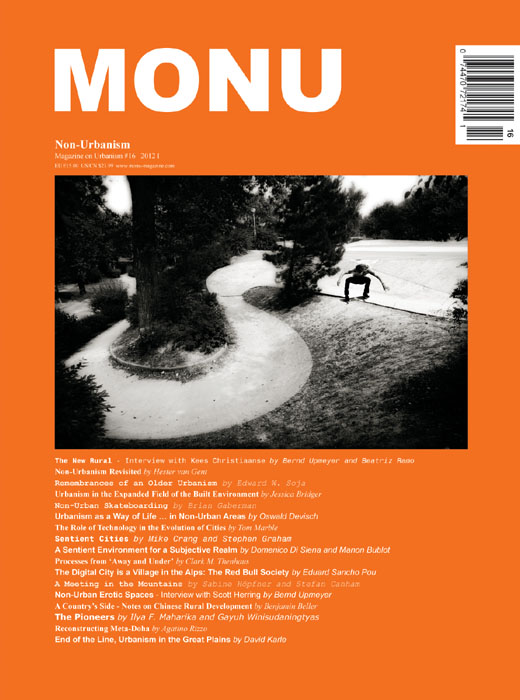
The digital city is a village in the Alps. The RED BULL Society.  (Artículo publicado en MONU #16 - NON-URBANISM, Abril 2012,  Rotterdam- Holanda)
RealizacionesPróxima

The digital city is a village in the Alps. The RED BULL Society. (Artículo publicado en MONU #16 - NON-URBANISM, Abril 2012, Rotterdam- Holanda)

(…)This 'bridging' will occur only partially through physical manifestations, but largely through otherwise 'invisible' structures and open-source processes and networks. Although the limits of digital cities are usually not physical, but, for example, economic as Eduard Sancho Pou describes in his contribution "The Digital City is a Village in the Alps: The Red Bull Society", one might find - especially in non-urban areas - "Truman Show"-like physical manifestations such as the village of the multinational corporation "Red Bull".(…) excerpt by Bernd Upmeyer, Editor-in-Chief
Competitions are Dead. Welcome to Proposals (Artículo publicado en (Non-)Essential Knowledge for (New) Architecture: 306090, Volume 15, Octubre 2013 , New York-Usa) Editor David L. Hays
RealizacionesPróxima

Competitions are Dead. Welcome to Proposals (Artículo publicado en (Non-)Essential Knowledge for (New) Architecture: 306090, Volume 15, Octubre 2013 , New York-Usa) Editor David L. Hays

In today’s scenario, architects must think strategically, offering solutions to problems of which the client isn’t even aware.
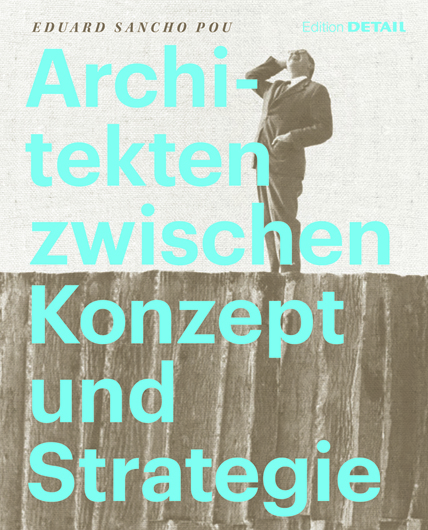
Architekten zwischen Konzept und Strategie
RealizacionesPróxima

Architekten zwischen Konzept und Strategie

In past years, architects have been confronted with a changed market, changed sets of tasks and also new requirements. Which strategies can they adopt to get commissions or spark interest in their projects? With selected examples, the author analyses the processes of individual architects since the 1950s. Beginning with the commencement of marketing in the North American post-war era he proceeds to then cast his view to contemporary times.
Transformations in society and politics, the changed requirements of clients, and also the crisis in the economy and financial circles all influence the professional existence of architects. While pure construction itself was the focus in previous times, today's architects must adopt a wide variety of roles in relation to clients – ranging from consultant to mediator and brand designer. The book is intended to inspire architects to consider new options and unusual paths. Seiten ca. 192
Abb. ca. 30 in Farbe, 20 s/w
format 19 x 23,5 cm
einband Hardcover
preis EUR (D) 39,00 / USD 55,00